Fahrenheit 451 and the Decline of Reading

Updated: Jun 2
Information

Book Title: Fahrenheit 451
Author: Ray Bradbury
Publisher: Ballantine Books
Publish Date: October 19, 1953
Genres: fiction, classics, dystopian, science fiction
Moods: dark, reflective, tense
Pace: medium
Synopsis
Fahrenheit 451 is about Guy Montag, a fireman in a world where books are illegal and reading is basically a crime. Instead of putting out fires, he burns books, and society is obsessed with screens, fast entertainment, and shallow distractions. But then Montag starts questioning everything he has been taught and realizes that maybe there is more to life than just following the rules and scrolling through whatever keeps people entertained. It is a story about curiosity, rebellion, and why losing books might mean losing a part of ourselves.
If you’ve been thinking more about your relationship with the internet and attention, you might like my post Offline is the New Cool, where I talk about how being constantly online affects the way we think and live.
Fahrenheit 451 Book Review
★★★★☆ (4.25/5) stars
I read this for a book club we have at my high school. I think the subject of this book is really interesting and I loved discussing it with my peers. Coincidentally, in my AP Research class, my research topic is about reading and so I was able to add lots of information about living in a world where we don't read and the effects of that. Other than that, I thought the book was a little boring. I couldn't connect with the characters. I understand that maybe this is the tone and style of the book and it is supposed to reflect the society and the way Guy Montag is thinking. However, I don't entirely think this is true because if this were the case, I believe the tone and style would have changed. This was a great book to discuss and a very easy modern classic to read. There is a lot of symbolism and questions that could come out of this book. In my high school, Fahrenheit 451 is taught in 9th grade literature. However, since I jumped straight into 10th grade Honors, I didn't read this book then. I believe that is where my critique stems from. Because I have read much more dense classics, I went into Fahrenheit 451 with this perspective and was left disappointed by the lack of depth.
If you’re interested in why reading matters beyond just school, I also wrote about this in The Beauty of Reading a Book You Love, where I reflect on what reading actually adds to our lives.
Who should read Fahrenheit 451?
If you are wanting to get into classics and don't know where to start, I think this is a great book to begin with. It is a relatively short book with simple sentences but with many potential discussion questions to explore.
Favorite Quote
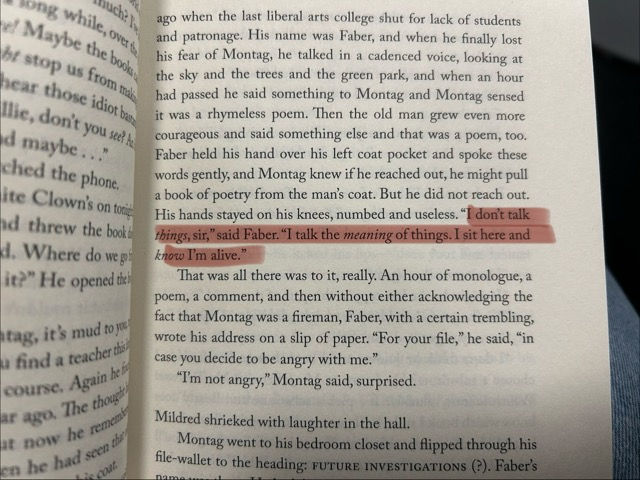
"I don't talk things, sir," said Faber. "I talk the meaning of things. I sit here and know I'm alive."
Fahrenheit 451's Relevance Today
The book touches a lot on a society that doesn't think because of constant stimulus. This is very similar to how our society is today. Many people cannot sit by themselves and their own thoughts. Furthermore, if they were to be in a conversation, much of what they say would be thoughts they have been fed from their algorithm. Instead of articulating their own thoughts, they repackage someone else's thoughts they heard or just agree with the other person. This is very closely related to an article I saw titled "Nobody has a personality anymore" by Freya India. This topic is a symbol of what Mildred represents in the book. She is constantly being fed information from the Family show she watches in the parlor, so all she actually talks about is that show.
Furthermore, the book mentions the lack of empathy that the society has. There is an abundance of research suggesting that empathy increases the more one reads. In Fahrenheit 451, the show and Mildred herself indulge in violence toward other beings. It is often said that teenagers are hurting one another and that dogs are being run over on the street. And obviously this makes sense; in a world that doesn't read and doesn't foster connection, people cannot feel empathy nor put themselves in another's shoes.
Reading is extremely important and has countless benefits. Reading builds critical thinking, empathy, and perspective. In a world where our time and attention are the biggest commodities, we must fight back the stimulation and choose the more mundane but extremely valuable things like reading and thinking. Fahrenheit 451 may not have been my favorite read, but it’s a reminder that reading and thinking critically are vital.
If you’re looking for a place to start with classics, I also put together a list of modern classics worth reading.
The Fight for a Human Attention Span
It is scary how much I related to the "constant stimulus" Bradbury described, even though he wrote this decades before the iPhone. I notice it in myself when I can't even wait for a two-minute microwave timer without pulling out my phone to scroll. We have become so used to being fed information that the act of sitting quietly with a book feels like an Olympic sport.
If we lose the ability to focus on a single narrative for more than thirty seconds, we lose the ability to think deeply about anything at all. That is the real danger Montag was fighting. It wasn't just about the physical books being burned. It was about the fact that people didn't care enough to stop it because they were too distracted by their "parlor walls." I don't want to wake up one day and realize my entire personality is just a collection of things I saw on an algorithm.

Sources, Credits & Links
Mood, genre and pace via The Storygraph


Comments